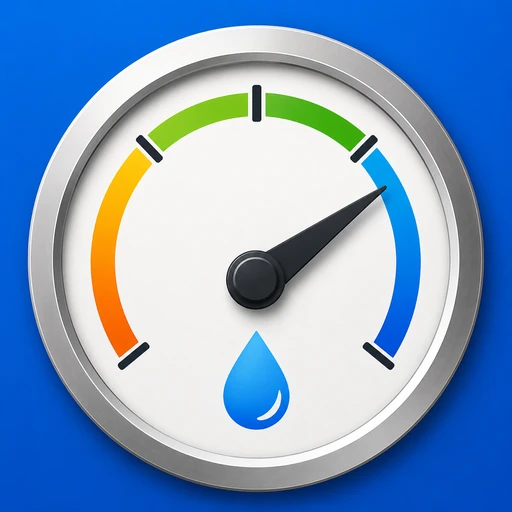
 Hygrometer
The five bands
The boundaries are not aesthetic choices. Each marks a point where something measurable changes.
| Band | Range | What changes here |
|---|---|---|
| Dry | Under 30% | Static builds, skin and airways dry out, timber shrinks. |
| Comfortable | 30–50% | The healthy range — comfortable for people, hostile to dust mites and mould. |
| Moderate | 50–60% | Still fine. Evaporation slows as this climbs; dust mites become viable. |
| Humid | 60–70% | Sustained readings here let mould take hold on cool surfaces. |
| Damp | Over 70% | Close to saturation. The air gives up water onto anything cool. |
The thresholds come from ASHRAE's comfort work and the EPA and WHO damp-building guidance — the same sources behind the "keep it between 30 and 50" advice you will find everywhere, with the reasoning attached.
Why the dial stops short of a full circle
A full circle has no beginning. A needle near the top could be at 5% or 95% and you would have to read the numbers to know which.
Sweeping 270° and leaving a gap at the bottom gives the two extremes distinct, unmistakable positions. The reading is legible at a glance and at a distance — which matters for a widget, where a glance is the entire interaction.
The four figures underneath
The dial answers "how humid is it". The numbers under it answer the questions that actually follow.
Dew point. The temperature the outdoor air would have to reach to saturate. Two things at once: a comparable measure of how much water is present, and the temperature below which any surface starts collecting water. It barely moves through the day, which is what makes it the one worth remembering.
Water in the air. Grams per cubic metre — the actual quantity. This is the figure that lets you compare today with a day in January, which the percentage cannot do. Almost nothing else in the category displays it.
Mixing ratio. Grams per kilogram of dry air. Unlike the others it survives the air being heated or lifted, which is why forecasters use it.
Condensation margin. How far the air temperature is above the dew point. When it closes to about a degree you get mist and fog; while it is wide, only genuinely cold things get wet.
What the needle is showing
The current outdoor relative humidity for your location, from Apple Weather.
Not the room you are standing in. No iPhone has a humidity sensor, so there is nothing on the phone capable of measuring the air around you — and inventing that number would make every other figure on the screen untrustworthy.
For outdoor questions — whether anything will dry, whether the evening will feel close, whether the car will be running with water at six — the outdoor reading is exactly the right one.
Reading it through the day
On a clear day with a large temperature swing, the needle travels a long way: high before dawn, low in mid-afternoon, climbing again after sunset. Almost none of that is water arriving or leaving — it is the temperature moving while the water stays put.
Which is exactly why the dew point sits underneath. When the needle swings and that number does not, nothing has actually changed about the air.